


Understanding the key measurements behind Cone Calorimeter testing and why they matter.
DNG TECHNO | BLOG DRAFT
When assessing how a material behaves in a fire scenario, it is rarely enough to ask whether it ignites. Researchers and testing teams may also need to understand how quickly heat is released, how the material loses mass and how much smoke is produced under defined test conditions.
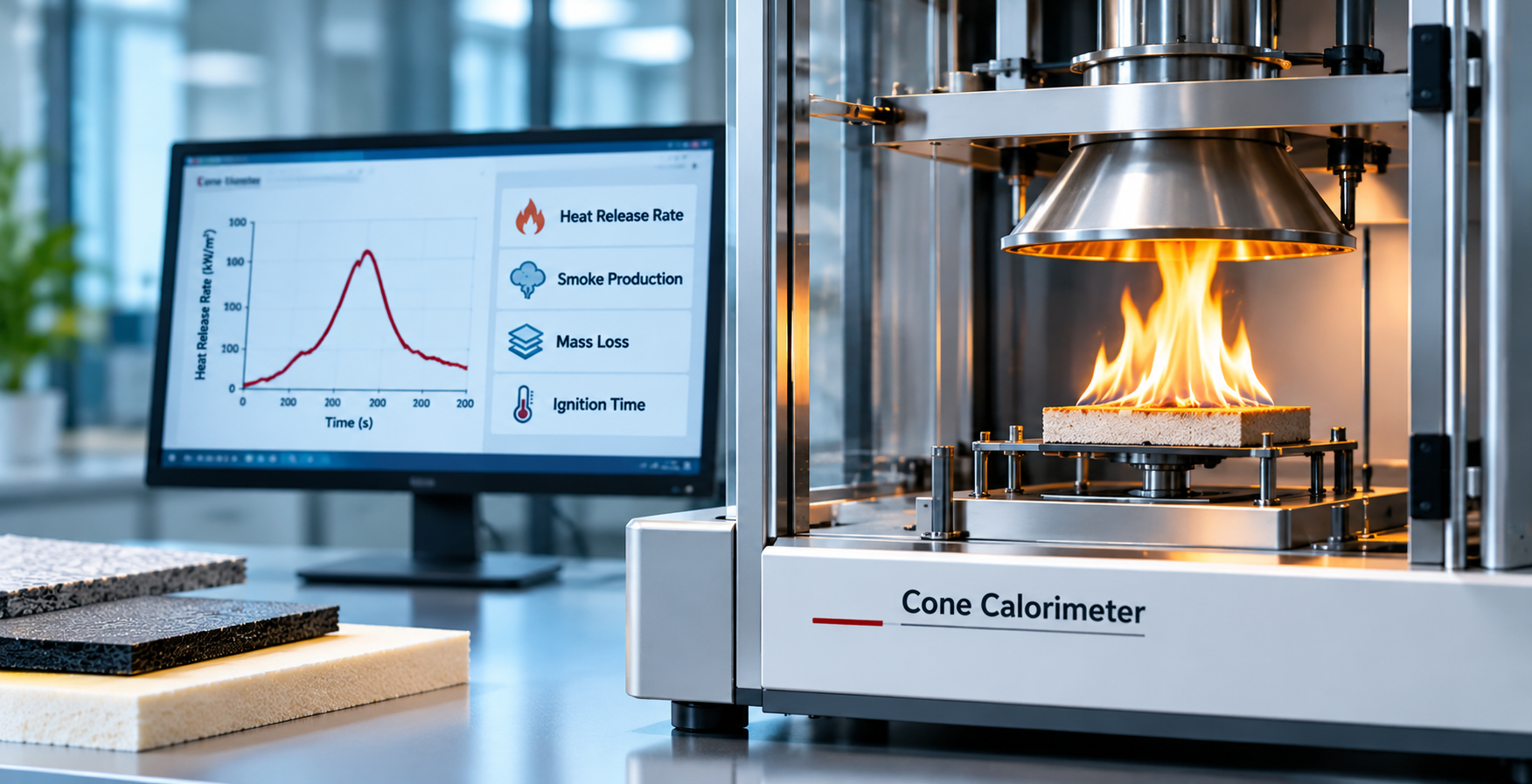
A Cone Calorimeter is an instrument used to study aspects of a material’s reaction to fire by exposing a sample to a controlled radiant heat source and measuring its response. The results can help researchers and product developers compare materials and better understand their fire behaviour.
So, what does a Cone Calorimeter actually tell us? The answer lies in the measurements it records—and in understanding what each measurement can and cannot tell us.
What is a Cone Calorimeter?
A Cone Calorimeter is commonly associated with the test method described in ISO 5660-1 and ASTM E1354. In broad terms, a specimen is exposed to a specified level of external radiant heat. As the material decomposes, ignites or burns under the test conditions, the instrument captures data that can be used to characterise its response.
One important principle behind the method is oxygen consumption calorimetry. The technique uses the relationship between the oxygen consumed during combustion and the heat released to estimate the rate of heat release. The test is conducted under controlled conditions, and the method’s requirements determine how the specimen is prepared, exposed and measured.
1. Heat release rate: How quickly is heat being released?
Heat release rate (HRR) describes the rate at which heat is released by a material during the test. It is often one of the most closely examined outputs because it helps indicate the intensity of the material’s burning behaviour over time under the specified test conditions.
The heat release rate can be plotted over time. This allows users to examine how the material’s response develops, including the peak heat release rate. Comparing this information across materials or formulations can support research and product-development decisions.
2. Time to ignition: When does the material ignite?
Time to ignition records the time taken for the specimen to ignite after exposure to the specified external heat flux, according to the test method and its criteria.
This measurement can help compare how different materials respond to a defined heating condition. It should not be interpreted in isolation: ignition behaviour depends on the test conditions and the material’s characteristics, and the result does not by itself describe overall fire safety in a real-world application.
3. Mass loss rate: How does the material change as it burns?
During testing, the specimen’s mass is monitored. Mass loss data can show how quickly material is being consumed or released as the test progresses. The rate of mass loss may provide additional context when considered alongside heat release and other measurements.
For researchers, this can be useful when comparing materials, studying formulation changes or examining how a material responds to a particular exposure.
4. Smoke production: How much smoke is generated?
Smoke-related measurements can provide information about the smoke produced during the test. Smoke is an important consideration in many fire-safety contexts, including enclosed environments and transportation applications, although the specific test methods and requirements for evaluating smoke may differ.
A Cone Calorimeter test can provide smoke-related data as specified by the method and instrument configuration. It is important to understand the exact measurement being reported and not treat it as interchangeable with results from other smoke-testing methods.
5. Total heat released: What is the cumulative heat output?
Total heat released represents the accumulated heat output over a defined period of the test. While heat release rate describes how quickly heat is being released at a given point, total heat released gives a cumulative view over time.
Used together, these measurements can help build a more complete picture of a specimen’s response under the specified test conditions.
Why are these measurements useful?
The value of Cone Calorimeter testing is not simply the number of measurements produced. It is the way those measurements help technical teams understand and compare material behaviour.
Depending on the application and the relevant test programme, the data may support:
- Research and development of new materials or formulations.
- Comparison of material performance under defined test conditions.
- Evaluation of changes made to a product or material composition.
- Technical investigations that inform material selection and product development.
- A broader fire-testing programme alongside other relevant tests and assessments.
Where can Cone Calorimeter testing be relevant?
Cone Calorimeter testing is used in material research and in a range of sectors where understanding reaction-to-fire characteristics can inform development and evaluation. Examples may include construction materials, cables and electrical products, transportation-related materials, plastics and research applications.
The appropriate test programme depends on the material, its intended use, customer requirements and applicable standards. A Cone Calorimeter result is one source of technical information; it should be considered alongside other relevant tests and the requirements for the final application.
Understanding the results matters as much as collecting them
A Cone Calorimeter can generate valuable information about heat release, ignition, mass loss and smoke-related behaviour. But the results need to be interpreted in the context of the test method, specimen, exposure conditions and purpose of the evaluation.
It is also important to remember that no single test provides a complete assessment of how a product will behave in every fire scenario. Different applications may require different test methods, combinations of tests or additional evaluations.
The right equipment supports meaningful testing
For laboratories, choosing a Cone Calorimeter involves more than comparing equipment specifications. The intended test methods, sample requirements, laboratory infrastructure, operator training, calibration and ongoing technical support all matter.
DNG Techno provides fire and material testing equipment and laboratory support solutions. If your organisation is evaluating Cone Calorimeter testing or planning to expand its fire-testing capabilities, understanding the test requirements is a useful place to begin.
Exploring Cone Calorimeter testing for your laboratory? Contact DNG Techno to discuss your application, testing requirements and equipment needs.